Showing posts with label Henry David Thoreau. Show all posts

Thursday, January 11, 2018

Here Are Three Things.

1.
Current Rotation
  • Iron & Wine, Beast Epic
  • Hiss Golden Messenger, Hallelujah Anyhow
  • Jason Isbell & the 400 Unit, The Nashville Sound
  • Beck, Colors
  • Sylvan Esso, Echo Mountain Sessions EP

2.
Henry wrote:
The twelve labors of Hercules were trifling in comparison with those which my neighbors have undertaken; for they were only twelve, and had an end; but I could never see that these men slew or captured any monster or finished any labor.
And also, somewhat more famously:
I say, let your affairs be as two or three, and not a hundred or a thousand; instead of a million count half a dozen, and keep your accounts on your thumb-nail. In the midst of this chopping sea of civilized life, such are the clouds and storms and quicksands and thousand-and-one items to be allowed for, that a man has to live, if he would not founder and go to the bottom and not make his port at all, by dead reckoning, and he must be a great calculator indeed who succeeds. Simplify, simplify.
His sometimes friend, perhaps mentor, perhaps benefactor, later critic, wrote this about schools:
We exercise their understandings to the apprehension and: comparison of some facts, to a skill in numbers, in words; we aim to make accountants, attorneys, engineers; but not to make able, earnest, great-hearted men. The great object of Education should be commensurate with the object of life. It should be a moral one; to teach self-trust; to inspire the youthful man with an interest in himself; with a curiosity touching his own nature; to acquaint him with the resources of his mind, and to teach him that there is all his strength, and to inflame him with a piety towards the Grand Mind in which he lives.
And of course, Emerson's words ring true today, as we consider the changes that technology has brought and will bring, and as we work to understand what education today might look like, if it were an education with a clear view of the future, or even one with absolute clarity of the present technological moment. In his day, Henry fretted about the post office, and the railroad, and the newspaper, and the speed with which people encountered new information, and Emerson exhorted those in his day to "Leave this military hurry and adopt the pace of Nature." As I've said before, I am not a Luddite, but I'd advocate for increased awareness of the sometimes frantic pace of life, for more mindfulness in the ways we spend our time and invest our attention--for a shared commitment not to be used by technology, but to use the tremendous platform we all have at our fingertips as a tool to do good and kind things in the world.

3.


Friday, February 15, 2013

A bit about beans.

From Thoreau's chapter "The Bean-Field":
The true husbandman will cease from anxiety, as the squirrels manifest no concern whether the woods will bear chestnuts this year or not, and finish his labor with every day, relinquishing all claim to the produce of his fields, and sacrificing in his mind not only his first but his last fruits also. (108)
This is hard. But it is also, perhaps, his answer to the question he asks early in that chapter:
What shall I learn of beans or beans of me? I cherish them, I hoe them, early and late I have an eye to them; and this is my day's work. (101)
It is a good reminder of the importance of work without expectation, a reminder of the importance of faith, a reminder of the importance of hope, of anticipation, of morning.

Earlier, in "Economy," Henry tells us:
I think that we may safely trust a good deal more than we do. We may waive just so much care of ourselves as we honestly bestow elsewhere. Nature is as well adapted to our weakness as to our strength. The incessant anxiety and strain of some is a well nigh incurable form of disease. (6)
And it's easy to agree--contemporary medicine would agree that "incessant anxiety" is indeed a cause of disease, if not disease itself. But to give up the claim to control our own fates? To relinquish the produce of our work? To lay not only our first fruits, but also our last, on the altar?

It is a curious thing how much we think we control. Surely, the work we do is important. Surely, Henry's beans would not have grown in that field had he not planted them, and hoed them, and cherished them, had he not tended to them, weeded them. Surely, the work we do has something to do with the results we receive. But how much? Henry points to the role of the sun, who sees no difference between his field and other areas of the earth, and the rain, which waters the land without regard for whether it is cultivated or not.

We live in a culture which encourages us to see the products of our labor as our possessions, possessions to which we lay exclusive title. (This is not unique to us, of course.) And so we believe we can somehow control our fates, that we are the masters of our own destinies. But, as it's asked in Matthew 6:
Can any one of you by worrying add a single hour to your life?
Again: this is hard. We want to do well, we recognize the need to produce, the desire to achieve, the importance of work. But Henry does not suggest that we abandon our work, but tells us that we should "finish [our] labor with every day," recognizing that the part we play in things, although of some importance, is (from a larger perspective) comparatively small. ("We are made to exaggerate the importance of what work we do; and yet how much is not done by us!" [6]) And the results of our work, whatever they are, are not ours alone, are not even--truly speaking--ours at all.

What's more, of course, is to put this in terms not of beans, but of self-cultivation, of the finer fruits Henry would have us pursue.

Thursday, February 7, 2013

Paying for Facebook.

I sometimes doubt if anyone who lived in the 1800s could have predicted the current state of media, but every time I read something like this, I'm convinced that Thoreau knew something about its use, if not the form it would eventually take:
For my part, I could easily do without the post-office. I think that there are very few important communications made through it. To speak critically, I never received more than one or two letters in my life--I wrote this some years ago--that were worth the postage. The penny-post is, commonly, an institution through which you seriously offer a man that penny for his thoughts which is so often safely offered in jest. And I am sure that I never read any memorable news in a newspaper. If we read of one man robbed, or murdered, or killed by accident, or one house burned, or one vessel wrecked, or one steamboat blown up, or one cow run over on the Western Railroad, or one mad dog killed, or one lot of grasshoppers in the winter,--we never need read of another. One is enough. If you are acquainted with the principle, what do you care for a myriad instances and applications? To a philosopher all news, as it is called, is gossip, and they who edit and read it are old women over their tea. Yet not a few are greedy after this gossip. (61)
We might go so far as to say that much of contemporary culture is driven by this gossip--and we shouldn't miss the fact that Facebook's home page is self-described as a "news feed."

Over the years that Facebook has been around, I've seen all manner of news in its "news feed." Some of it clearly gossip by any standard, but nearly all of it gossip by Thoreau's standard. In fact, I might go so far as to adapt what Henry says about the post-office and to say the same about social media--to speak critically, as he does, I never read more than a very few things on Facebook, or Twitter, or Instagram, or Myspace (back in those days) that were what I would call "important communications."

This is not to say, though, that I think that Facebook's "news feed" is poorly named, since there's very little difference between what I find there and what I might find on the home page of nearly any major news corporation. Most of what we find today in the news (and I wonder if it has been different at any point in the last two centuries) is indeed a myriad instances and applications, either of things that we already know or (which is worse) of things that we don't need to know.

I've been talking with people lately about social media, about the value they see in it, about the risks one would run by abandoning the lot. And of course, the concern that most people have is that they will miss something of importance. But even if we concede that there are, occasionally, items of importance on Facebook et al., how frequently do they appear? How much gossip must we read before we find "important communications"? How many pictures of cats and status updates about what our acquaintances are eating for lunch or watching on television will we have to read before we discover something that makes it worth the time we spend? (And, we might also ask, if these things are truly important, will we not learn of them through other means?)

Henry is quite clear when it comes to spending:
the cost of a thing is the amount of what I will call life which is required to be exchanged for it, immediately or in the long run. (19)
Of course, I'm using this line out of context--Henry is writing about the cost of housing, but our economy today is different from that of his time. We don't pay to use Facebook (not directly, I mean), and the world is full of people who have at one point been irrationally angry about the prospect that Facebook might begin charging users for its services. At one point (this may still be true, but I'm not sure), Facebook went so far as to put a disclaimer on its sign-in page stating that it was and would always be free. But if we use Thoreau's definition of cost, social media is anything but free. How much life do we exchange to use it? How much of our time and attention does it take?

I would be far from kidding if I said that there are a great many people who pay a great deal for the use of supposedly free social media.

Monday, February 4, 2013

I am not a Luddite. But still.

I was looking back through "Economy" the other day, and re-read these lines:
As with our colleges, so with a hundred "modern improvements;" there is an illusion about them; there is not always a positive advance. The devil goes on exacting compound interest to the last for his early share and numerous succeeding investments in them. Our inventions are wont to be pretty toys, which distract our attention from serious things. They are but improved means to an unimproved end, an end which it was already but too easy to arrive at; as railroads lead to Boston or New York. (33-34)
And perhaps I'll give you these lines, with no introduction except to say that they're all from the first page or so of updates on Facebook that showed up in my news feed recently:
Hahahahaha! Figures.
Day off--[dog] to the doggy spa, grocery shopping, oh and the courthouse to pay a freaking speeding ticket!!
It makes me so happy to hear NEW DEFTONES on the radio here in [location]!!!! Now if we could only hear more new music worth listening to instead of old Metallica and Nickelback;)
just wrote a poem
I actually think the Blackberry 10 OS looks pretty sweet. Probably my next phone. Check out this video...
Thank you, global warming, for more catastrophic weather coming our way. And thank you, global warming deniers, for fighting every single effort to combat this destruction of our world. No, seriously.
People who don't drink coffee should not be in charge of making coffee
Well, Facebook since you asked, my cold is a tad better. But with the "wintry mix"--wet stuff freezing as it falls plus pockets of water from yesterday's flooding freezing over UNDER the predicted snow to come later this morning--I have a feeling I should leave early to get to my 9:25 class. Grumble...
I seriously have a chi chi chi chia pet growing on my head. I don't know how people who work a 9-5 get anything personal done. I have more freedom with my schedule and still can't seem to get my hair did.
Much of the time, when I look at Facebook (or Twitter, or Instagram, or whatever other social medium), I end up wondering what the point is. Did I learn anything? Did I add anything of value to my life? We live in a time when instant (or near-instant) communication is viewed as a great achievement, a time when almost everyone has the ability to say almost anything to almost anyone.

Is this a good thing?

Sometimes, of course, it's great to be able to get in touch with someone quickly and almost effortlessly. But the speed and ease with which we can do this lends itself to a great deal of digital noise, noise that creates what I think Neil Postman would call a sea of irrelevance, an overwhelming wave of unrelated facts that have little to no bearing on our lives. Your dog is at the groomer, and you got a speeding ticket? You like to listen to New Deftones instead of Metallica? You're interested in the new Blackberry? Upset about global warming? Had a bad cup of coffee? Wrote a poem? Still sick? Need a hair cut?

It's not that I don't agree, because sometimes, I do. And it's not that I don't care, because sometimes, I do. It's that I'm not convinced that much of this information has any bearing on the real material conditions of my life, on the actions or potential actions that I'll take today. And sometimes, I'm not convinced that any of it has any connection to my life--you know, the actual one that I live, aside from the digital comments and likes and plus-ones and re-Tweets and what-not.

And to be completely honest, I'm not convinced that much of this information has any bearing on the real material conditions of the life of the person who wrote it.

I should say: I'm not a Luddite. But I am worried about something that I think Thoreau points to here, to our inventions being "pretty toys" and "improved means to an unimproved end," and I think we'd all be better served by a serious consideration of the ends, than by a fascination with the newest means.

Thursday, January 24, 2013

Now, we toe the line.

We're still working our way through "Economy" in my sixth period class, and today, I'm thinking about this line:
In any weather, at any hour of the day or night, I have been anxious to improve the nick of time, and notch it on my stick too; to stand on the meeting of two eternities, the past and the future, which is precisely the present moment; to toe that line. (10)
I remember a few years ago, a group of students who were certain that the expression was "to tow the line." In their minds, they had an image of a person hauling something heavy, pulling a rope in spite of the difficulty.

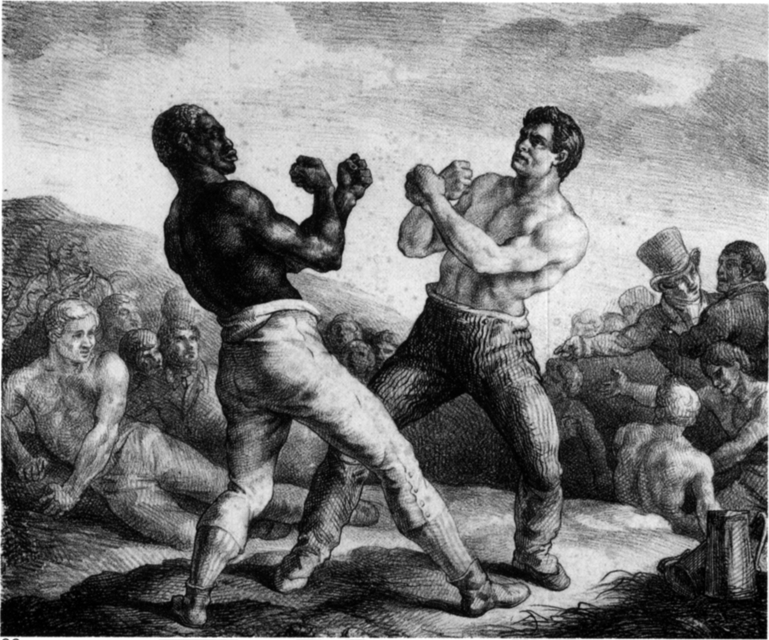
Of course, they knew nothing about boxing (which is not the only possible source of this phrase, but a likely reference for Thoreau's time).

Because it's not that at all. It's not about pulling a heavy weight. The image shouldn't be of a person turning away from the weight, leaning away from the burden in an effort to pull it forward. The image is not one of turning away, but of standing up and facing an opponent, especially when it feels as if that opponent has nearly beaten you.

The image, then, is not of burden, but of bravery, and it's important to keep that in mind when we're reading this passage. Thoreau uses the expression, it seems, as a way of remarking on the difficulty of the act. It reminds me of a line from an essay by Annie Dillard that I especially like, one in which she describes a flight by the stunt pilot Dave Rahm:
His was pure energy and naked spirit. I have thought about it for years. Rahm's line unrolled in time. Like music, it split the bulging rim of the future along its seam. It pried out the present. We watchers waited for the split-second curve of beauty in the present to reveal itself.
And perhaps there's something here, amid Thoreau and Dillard, about my relationship to running. The run, often, is a time of distraction, a time during which the mind moves aimlessly, not idling but simply wandering. But there are times, especially when the effort of the run is high, of focus--not a focusing of the mind, but a quieting of it; not the moment-to-moment remembering what's just happened or projecting what might happen next; not hope, not desire, not wish, merely presence.

And it's at these moments, often, that the physical suffering of running is at its greatest, but in these moments, toeing this line, there isn't the desire to escape the suffering or to ignore it--merely the acceptance of it in the present experience of the moment. And with that acceptance, strangely enough, the suffering ceases to be suffering--I guess because when we suffer, we wish for things to be other than as they are.

I've recently heard several runners remark on the feeling they had when they ran their best times, and all of them have said that these were the races when they hurt the least. I can't help but think that it's not because the physical experience was different--they didn't run a fast time because their body didn't hurt while putting forth a maximal effort. Instead, I think it's because the relationship to the physical experience was different--that instead of wishing for the hurt to be easier/over/different, they were fully present with the experience.

Thursday, January 17, 2013

In which I consider Herculean labor

I'm tired today. And I'm reading the first chapter of Walden with my sixth period class. So perhaps inevitably, I find myself drawn to this passage today:
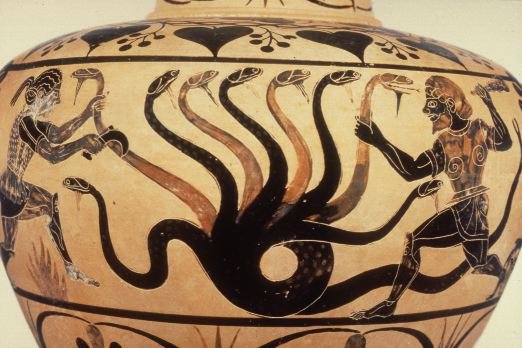
The twelve labors of Hercules were trifling in comparison with those which my neighbors have undertaken; for they were only twelve, and had an end; but I could never see that these men slew or captured any monster or finished any labor. They have no friend Iolas to burn with a hot iron the root of the hydra's head, but as soon as one head is crushed, two spring up. (2)
The second labor of Hercules
To be clear: my intention here is not to complain--in fact, a student said something to me earlier today about life being difficult, and I told her that was absolutely not the case, at least for me: my life, by almost any standard, is fairly easy.

But there is a tendency these days to fill our days beyond capacity, especially where work is concerned. I wrote a few weeks ago about busyness (or business), and perhaps this practice of over-filling our plates has something to do with societal ennui, perhaps it has something to do with the cost of labor in an increasingly competitive market, perhaps it has something to do with being driven, as so many of us are.

I've been thinking a great deal lately about the difference between success and excellence--it's an issue that came up at a USATF event I went to back in Daytona back in November and then again at a coaching school I attended in Tampa in December. I've been thinking about this difference in relationship to running, but of course, it's relevant to thinking about (almost) anything, and perhaps it's relevant here.

Success, as I see it, is defined externally, against an external (and probably concretely measurable) standard, while excellence is defined internally, against an internal standard. Success, since it's measured against an external standard, is achievable, but unsatisfying in the long term. A runner might have a particular goal (running a particular time, for instance, or winning a particular race, or beating a particular competitor, for instance), and while the runner would certainly be pleased to achieve that goal, the only thing on the other side of that goal is another (presumably more difficult) goal. And once that new goal is envisioned, the achievement of the previous goal pales, at least slightly. The response to success, we might say, is pride followed by a tinge of dissatisfaction.

We could say as much for almost any profession: that a person might have a particular goal (a promotion, or a salary, or a contract, or an office with a window, etc.), but the result of achieving that goal is probably the same as what we see with the runner--initially, pride in the achievement, but then dissatisfaction with the achievement in the face of a new goal.

Excellence is another thing. Because it's internally defined, excellence is unachievable in a practical sense. And if a person chooses to aim for excellence rather than for success, that person's relationship to the task (and to others) changes--for the good, I think. Since excellence (unlike a specific goal of success) is ultimately unachievable, we see the task from a position of humility, rather than pride. And since excellence is unachievable, we can see others engaged in the same pursuit not as competitors who must be beaten or dominated, but as ones who are also engaged in this impossible but worthwhile pursuit. Thus, we must respect both the perfection of the goal and the effort of others who have chosen to pursue it.

I don't know that I have the time here to explore this reference fully, but what comes to mind immediately is this line from Gerard Manley Hopkins:
   --the achieve of; the mastery of the thing!
In Hopkins's poem, what the speaker sees is not success, but excellence, and in the next lines, we see pride (among other things) buckle, and the speaker is overcome with the perfection of what he has witnessed.

All of this starts to sound like I'm moving quite a bit away from Thoreau's text, but I don't think I am. Just a few paragraphs later, he writes:
Most men, even in this comparatively free country, through mere ignorance and mistake, are so occupied with the factitious cares and superfluously coarse labors of life that its finer fruits cannot be plucked by them. (3)
I'd venture to say that what I'm describing here in terms of success are too often what Henry calls the "factitious cares and superfluously coarse labors of life," and that when Henry writes of life's "finer fruits," we wouldn't be far away if we thought the things we might find if we pursued excellence.

Friday, December 21, 2012

In which I say something about busyness and wildness.

The other day, I stumbled back on Tim Krieder's essay on "The 'Busy' Trap" in the New York Times. Krieder writes:
Busyness serves as a kind of existential reassurance, a hedge against emptiness; obviously your life cannot possibly be silly or trivial or meaningless if you are so busy, completely booked, in demand every hour of the day. I once knew a woman who interned at a magazine where she wasn’t allowed to take lunch hours out, lest she be urgently needed for some reason. . . . I can’t help but wonder whether all this histrionic exhaustion isn’t a way of covering up the fact that most of what we do doesn’t matter.
This is, in at least some way, Baudrillard, right?
I am not joking: people are not looking to amuse themselves, they seek a fatal diversion. Not matter how boring, the important thing is to increase boredom; such an increase is salvation, it is ecstasy. It can be the ecstatic amplification of just about anything. . . . This is the only solution to the problem of 'voluntary servitude', and moreover, this is the only form of liberation: the amplification of negative conditions. ("Toward a Principle of Evil")
I read Krieder's essay when it was published back in June, but it was interesting to see it again today in light of the fact that I'm preparing to read Walden (or at least significant parts of it) with my classes in January, so I've been spending some time with Henry over the last week or so.

Henry writes (famously, of course):
Most men, even in this comparatively free country, through mere ignorance and mistake, are so occupied with the factitious cares and superfluously coarse labors of life that its finer fruits cannot be plucked by them.
I think most people get that idea, at least at some level if not at the level that Thoreau means it, as long as they have some idea of what the "finer fruits" of life might be.

And we might note that it's not hard to see the etymology of business--I had an interesting conversation with a student a couple of weeks ago about his plan to major in business: What, I asked, did he intend to make himself busy with?

But let me move back a page or so, to where Henry says:
Better if they had been born in the open pasture and suckled by a wolf, that they might have seen with clearer eyes what field they were called to labor in.
Of course, there's a reference here to Romulus and Remus, to the founding of an age--and, we might say, to the steering of the course of Western (arguably, world) history by an individual or two (fictional or not). It's a reference, perhaps, to Emerson's exhortation to rediscover the aboriginal self, to influence an age by abandoning society's values and returning to the judgement of the intuition:
A man Caesar is born, and for ages after we have a Roman Empire. Christ is born, and millions of minds so grow and cleave to his genius, that he is confounded with virtue and the possible of man. An institution is the lengthened shadow of one man . . .and all history resolves itself very easily into the biography of a few stout and earnest persons. ("Self-Reliance")
But this move is problematic, as anyone who makes it past the famous second chapter of Walden will recognize--everyone who's passed high school English probably remembers this sentence from "Where I Lived, and What I Lived For":
I wanted to live deep and suck out all the marrow of life, to live so sturdily and Spartan-like as to put to rout all that was not life, to cut a broad swath and shave close, to drive life into a corner, and reduce it to its lowest terms, and, if it proved to be mean, why then to get the whole and genuine meanness of it, and publish its meanness to the world; or if it were sublime, to know it by experience, and be able to give a true account of it in my next excursion.
What's unfortunate, of course, in the teaching of Thoreau's work, is that (at least in my experience) most people fall into the very trap that Henry wants to avoid: they assume that Henry's experience is an affirmation of Emerson's philosophy, and that life is, indeed, sublime. But it's not that easy, is it? This rejection of society's so-called busyness? This attempted rediscovery of the uncivilized self? This wildness?
As I came home through the woods with my string of fish, trailing my pole, it being now quite dark, I caught a glimpse of a woodchuck stealing across my path, and felt a strange thrill of savage delight, and was strongly tempted to seize and devour him raw; not that I was hungry then, except for that wildness which he represented. Once or twice, however, while I lived at the pond, I found myself ranging the woods, like a half-starved hound, with a strange abandonment, seeking some kind of venison which I might devour, and no morsel could have been too savage for me. ("Higher Laws")
Now perhaps life is, in fact, ultimately sublime. But to reach that conclusion based on Henry's experiment requires an understanding of that term that encompasses a wildness, a savageness, that most of us are uncomfortable with.

Which brings us back, perhaps, to Krieder, to Baudrillard, to this idea of the banality of industrialized society, to the filling of days with constructed demands, to what Thoreau calls "factitious cares," to what Krieder calls "histrionic exhaustion," to what Baudrillard calls "fatal diversion." What, I think it's fair to ask, are the alternatives?

Here's one philosopher's answer.

Tuesday, November 20, 2012

Here are slightly more than a half dozen things before Thanksgiving.

1.
Have you listened to the new Joshua James album yet? If not, you should. I promise you'll like it.

2.
Our Thanksgiving holiday starts today, and I am indeed grateful.

3.
Mike Doughty has a new album, too--The Flip Is Another Honey. Don't tell him I said so, but there are things about it that sound like his Soul Coughing days. And generally, I mean that as a good thing. There are some interesting covers here, and I'm not sure about how I feel at the album as a whole, but there are some things I like about it--I guess I'll have to spend a bit more time with it.

4.
I ran a new 5k PR a week or so ago at the City of Winter Garden 5k. I ran 19:33, which took 9 seconds off my previous best time. It looked like lots of the cross country team from West Orange was running in this race, and the pace at the start was pretty quick--5:00/mi for the first bit.

I settled in as quickly as I could to run 6:00/mi for the first mile--the plan was to run a 6:10/mi effort, but to actually run 6:00-6:05/mi for the first mile since it's a slight downhill. Lots of people went out fast, but by the time we hit the first mile marker, people were starting to fade. Me, too, looking at the splits, but not as much as other people were fading. About half a mile in, there were somewhere around 25 people in front of me, which had dwindled to maybe 18 or so by the mile.

The pace slipped a little in the middle of the second mile as we were headed uphill, but I moved up pretty steadily during the second mile and most of the third, and was in 7th with about 400m to go and 8th and 9th right on my shoulder, when my left hamstring tweaked a bit--just as we were making the turn toward the finish. I managed to fend off one of the two on my shoulder, but the younger one--one of the high school xc runners--got me by two seconds.

5.
So for the last week, I've been rehabbing the hamstring again, and looking forward to running in the OUC Half on December 1.

6.
Regarding the promise I made in #1 above: What I should say is that if you don't like the new Joshua James album, I'm not certain that we can be friends.

7.
My classes have been reading and discussing Emerson--primarily "Self-Reliance" and "The Divinity School Address." I enjoy reading and teaching Emerson's work, but mostly, it makes me want to read Thoreau.

Friday, July 6, 2012

A few words about test results and other things.

1.
AP scores are in, and my students did well. Although some people like to talk about "passing" the AP exam, that's not really an accurate way to talk (or think) about AP scores--we really ought to talk in terms of "earning a qualifying score."

In terms of "earning a qualifying score," my students this year did well, about as well this year as they did the last two years, with almost all of them earning a score of three (which means "qualified") or higher. But what was great news is that this year, I had more students earn scores of four ("well qualified") and five ("extremely well qualified") than I've ever had.

So it was a good year: a great group of students, and I think their scores confirm that some of the changes I've made to the course over the last several years have moved things in the right direction.

2.
When I worked in the car business and we finished a great month, we'd have just a few minutes of basking in the warm glow of profit during the first few minutes of our morning managers' meeting.

And then Rich, our general manager, would look at us and say, "Alright, that was last month. What are we going to do this month? What do you have today?"

3.
So it's time to get focused on plans for next year's course.

There will be some more data coming from the College Board next week that will help with the planning process, but I'm ready to get started.

4.
Also, it ought to go without saying, but in today's high-stakes testing culture, I'm afraid it doesn't: we should all keep in mind that these scores are just one measure of student learning. They're certainly not the only measure, and they're not necessarily the best.

5.
I had a rather interesting conversation with a couple of my summer school students the other day regarding Henry David Thoreau. They have been reading a selection from Walden, and we got to talking about how we might understand HDT in terms of Plato vs. Aristotle, or in terms of idealism vs. materialism.

I'm convinced that Henry is (was) an idealist, more a student of Plato than of Aristotle, but it's also clear that he wants those ideals only so long as they can affect what we might call real life, only so long as they can manifest themselves in material terms:
To be a philosopher is not merely to have subtle thoughts, nor even to found a school, but so to love wisdom as to live according to its dictates, a life of simplicity, independence, magnanimity, and trust. It is to solve some of the problems of life, not only theoretically, but practically. . . . How can a man be a philosopher and not maintain his vital heat by better methods than other men? (from "Economy")
And:
The title wise is, for the most part, falsely applied. How can one be a wise man, if he does not know any better how to live than other men?--if he is only more cunning and intellectually subtle? . . . It is pertinent to ask if Plato got his living in a better way or more successfully than his contemporaries,--or did he succumb to the difficulties of life like other men? (from "Life Without Principle")
And perhaps more practically:
. . . it does not depend on what kind of paper you drop into the ballot-box once a year, but on what kind of man you drop from your chamber into the street every morning. (from "Slavery in Massachusetts")

Thursday, August 11, 2011

In which I say eleven things about a nail and one about a poem

1.
So I got this hole in my foot. Actually, it was a nail.

2.
They re-roofed our house a few weeks ago, and since then, we've picked up fifty nails at least from the yard. This one, I found the hard way.

3.
This one that I found with my foot was pretty rusted.

4.
It'd been a while since I'd had a tetanus shot, so we got to spend our Sunday evening visiting the fine folks at the Emergency Room in South Lake Hospital. Fortunately, things were quiet, so we were in and out of there in very little time.

5.
I previously had no idea what our copay was for an ER visit. Now I know. It's a hundred bucks.

6.
The nurse in the ER was delighted when she heard that I was wearing Crocs when I stepped on the nail. I know, you're going to tell me they're ridiculous looking, and you're right. But they also don't hold on to all of that bacteria that fill my retired running shoes, so evidently, if you're going to step on a nail, Crocs are pretty much an ideal thing to be wearing.

7.
Actually, work boots would be ideal. I stepped on a nail a couple of weeks ago while I was wearing work boots and didn't even know it until I heard the nail scrape against the driveway. But if you're going to go all the way and get a puncture wound, it seems that Crocs are much preferable to other forms of footwear.

8.
I kept trying to talk to everyone in the ER about John Thoreau. He was Henry's brother, and he died a pretty gruesome death of tetanus after cutting himself while stropping a razor. He was 27, and he died in Henry's arms. "That's not the way I want to go," I kept telling people.

9.
So I got a tetanus shot.

10.
But the good news was that the ER doc cleared me to run, as long as I promised to clean the wound well as soon as I finished running.

11.
So I promised, and I ran the next morning, and I cleaned the wound well when I was done. But while I was running, it was hard to resist thinking a little about Steve Prefontaine, who won the three mile at NCAAs in 1970 with a dozen stitches in his foot. It's hard to imagine enduring pain like that.

12.
Also, did I mention I have a poem over at Wonderfort?

Wednesday, July 13, 2011

In which I note a few things about cultivation and patience

1.
Socrates, in Plato's Phaedrus:
Would a husbandman, who is a man of sense, take the seeds, which he values and which he wishes to bear fruit, and in sober seriousness plan them during the heat of summer, in some garden of Adonis, that he may rejoice when he sees them in eight days appearing in beauty? at least he would do so, if at all, only for the sake of amusement and pastime. But when he is in earnest he sows in fitting soil, and practises husbandry, and is satisfied if in eight months the seeds which has sown arrive at perfection?
2.
Henry David Thoreau, in "The Bean-Field" from Walden:
Ancient poetry and mythology suggest, at least, that husbandry was once a sacred art; but it is pursued with irreverent haste and heedlessness by us, our object being to have large farms and large crops merely. . . . He sacrifices not to Ceres and the Terrestrial Jove, but to the infernal Plutus rather. By avarice and selfishness, and a grovelling habit, from which none of us is free, of regarding the soil as property, or the means of acquiring property chiefly, the landscape is deformed, husbandry is degraded with us, and the farmer leads the meanest of lives.
3.
Percy Bysshe Shelley, from A Defence of Poetry:
Pleasure or good, in a general sense, is that which the consciousness of a sensitive and intelligent being seeks, and in which, when found, it acquiesces. There are two kinds of pleasure, one durable, universal, and permanent; the other transitory and particular. Utility may either express the means of producing the former or the latter. In the former sense, whatever strengthens and purifies the affections, enlarges the imagination, and adds spirit to sense, is useful. But a narrower meaning may be assigned to the word utility, confining it to express that which banishes the importunity of the wants of our animal nature, the surrounding men with security of life, the dispersing the grosser delusions of superstitions, and the conciliating such a degree of mutual forbearance among men as may consist with the motives of personal advantage.

Monday, July 4, 2011

In which we arrive in a new home

1.
Well, we made the big move this weekend. There are still some odds and ends to move, but most of our things are at the new place.

2.
Some of that stuff is in the garage at the moment, because we're trying out to figure what might go where.

3.


4.
That twenty-six-foot sucker was a beast to drive, especially with the perpetual construction on Highway 50.

5.
I went for my first run in just over two weeks this morning. It was humid, but not too hot, and it felt good to be running again.

To be honest, the first mile or so didn't feel so good. But after that, it felt good to be running again.

6.
You know you're living in the country when you're out running and you see more rabbits in the road than cars.

7.
I'm on duty this evening, but being closer to campus makes that a bit easier.

8.
Henry David Thoreau, from Walden:
When first I took up my abode in the woods, that is, began to spend my nights as well as days there, which, by accident, was on Independence Day, or the Fourth of July, 1845, my house was not finished for winter, but was merely a defence against the rain, without plastering or chimney, the walls being of rough, weather-stained boards, with wide chinks, which made it cool at night. The upright white hewn studs and freshly planed door and window casings gave it a clean and airy look, especially in the morning, when its timbers were saturated with dew, so that I fancied that by noon some sweet gum would exude from them. To my imagination it retained throughout the day more or less of this auroral character, reminding me of a certain house on a mountain which I had visited a year before. This was an airy and unplastered cabin, fit to entertain a travelling god, and where a goddess might trail her garments. The winds which passed over my dwelling were such as sweep over the ridges of mountains, bearing the broken strains, or celestial parts only, of terrestrial music. The morning wind forever blows, the poem of creation is uninterrupted; but few are the ears that hear it. Olympus is but the outside of the earth everywhere.
9.
By accident, indeed.

10.
Happy 4th of July!

I'm looking forward to the fireworks this evening.

Monday, November 8, 2010

In which I list fifteen authors at the request of James Mayo

1. J. M. Coetzee
2. Li-Young Lee
3. Walt Whitman
4. Michel Foucault
5. Homer
6. Henry David Thoreau
7. Jack Kerouac
8. Beth Ann Fennelly
9. Franz Kafka
10. Ralph Waldo Emerson
11. James Joyce
12. Flannery O'Connor
13. Brad Watson
14. Tennessee Williams
15. Allen Ginsberg

Tuesday, February 2, 2010

Walden and The Bean-Field

At the conclusion of "The Bean-Field," Henry David Thoreau writes:
The true husbandman will cease from anxiety, as the squirrels manifest no concern whether the woods will bear chestnuts this year or not, and finish his labor with every day, relinquishing all claim to the produce of his fields, and sacrificing in his mind not only his first but his last fruits also.
I'm telling my students today that if they understand this sentence, then they understand the better part of Thoreau.

Thursday, January 7, 2010

Walden, Materialism, CCR, Letters

In the very first paragraph of Walden, Henry David Thoreau writes:
At present I am a sojourner in civilized life again.
"At present," he writes. As if the future might hold an escape from this so-called "civilized life" that he will later call a life "of quiet desperation."

There is so much about which I disagree with Thoreau. But it's hard for me to argue with his critique of materialism, which in his day was certainly becoming rampant and in ours has become perhaps exponentially more so. He describes himself as a "sojourner," indicating from the very beginning of Walden that he is in this "civilized life" but not of it, that his life away from society and its love of stuff and money (and the work that must be done to earn the money to pay for that stuff) is really his home.

All this is to say, perhaps, that I've started teaching Walden yet again in my classes this week, so I should give you fair warning. Those of you who know me well know that every time I read Walden, my critique of contemporary materialism becomes a bit...intensified, shall we say?. So consider yourself warned.

In other news, I'm listening to CCR's Willie and the Poor Boys on vinyl at the moment, and I don't know that I've ever spent a better twenty bucks on music. (I know, I know, I just was complaining about materialism, and here I am spending twenty bucks on an LP. Do I contradict myself? Very well then, I contradict myself.) I've listened to it a bazillion times in iTunes, but it's quite a different experience on vinyl.

I've also been working on the last of this year's recommendation letters to go along with former students' college applications. And there are several that I put off writing, not deliberately, and not because I had nothing to say, but perhaps because I had too much. The length of the last two letters has been twice what I normally write, and both of them have been pretty difficult for me to bring to a conclusion. In both cases, for students whom I taught for three years, students whom I will miss a great deal when they graduate this year.

Monday, February 2, 2009

Poverty and Light

1. In "Sight into Insight," an essay first published in Harper's and then collected in Pilgrim at Tinker Creek, Annie Dillard writes:
But if you cultivate a healthy poverty and simplicity, so that finding a penny will make your day, then, since the world is in fact planted in pennies, you have with your poverty bought a lifetime of days.
And:
I cannot cause light; the most I can do is try to put myself in the path of its beam. It is possible, in deep space, to sail on solar wind. Light, be it particle or wave, has force: you rig a giant sail and go.
2. In "Economy," the first chapter of Walden, Henry David Thoreau writes:
But lo! men have become the tools of their tools. The man who independently plucked the fruits when he was hungry is become a farmer; and he who stood under a tree for shelter, a housekeeper. We now no longer camp as for a night, but have settled down on earth and forgotten heaven
3. In "Pride Has Turned Us into Liars," Ryan Alexander sings:
And what we have traded here for concrete and steeples
Are warm blooded people, the orphaned and the widowed
And:
And what we have traded here for suburbs and comfort
Are poor single mothers,
We're turning children into soldiers
4. In "A Jealous Father," I write:
Is this the cost of knowledge? Or a way of explaining to ourselves the
sweating and earning and growing and eating and sometimes starving
that fills our days and nights—burning candles at both ends, as they say,
tilling the earth, as they say, and finding that there is never quite enough to go around.
5. In "Economy," Henry also writes:
I cannot believe that our factory system is the best mode by which men may get clothing. The condition of the operatives is becoming every day more like that of the English; and it cannot be wondered at, since, as far as I have heard or observed, the principal object is, not that mankind may be well and honestly clad, but unquestionably, that the corporations may be enriched.
6. In The Republic, Socrates says:
. . . the guardians were not to have houses or lands or any other property; their pay was to be their food, which they were to receive from the other citizens, and they were to have no private expenses; for we intended them to preserve their true character of guardians.
7. In "Ain't No Reason," Brett Dennen sings:
People walk around pushing back their debts,
Wearing paychecks like necklaces and bracelets,
Talking about nothing, not thinking about death
8. And in his essay "My Wood," E. M. Forster writes:
The Gospels all through couple stoutness and slowness. They point out what is perfectly obvious, yet seldom realized: that if you have a lot of things you cannot move about a lot, that furniture requires dusting, dusters require servants, servants require insurance stamps, and the whole tangle of them makes you think twice before you accept an invitation to dinner or go for a bathe in the Jordan. Sometimes the Gospels proceed further and say with Tolstoy that property is sinful; they approach the difficult ground of asceticism here, where I cannot follow them. But as to the immediate effects of property on people, they just show straightforward logic. It produces men of weight. Men of weight cannot, by definition, move like the lightning from the East unto the West, and the ascent of a fourteen-stone bishop into a pulpit is thus the exact antithesis of the coming of the Son of Man.

Thursday, January 29, 2009

Brooklyn, Thoreau, and Making the Self

Over at Alsace-Lorraine, Brooklyn Copeland writes:
The life you lead shows up in your poetry. It does.
Now, I don't want to be a tuba player (as she suggests later in that post), but I've also been reading some Thoreau lately. Her post reminds me of these lines:
My life is the poem I would have writ,
but I could not both live and utter it.
Of course, she's not taking the same stance as Thoreau takes in those lines, but I do think it's important to consider the relationship between self and our writing. In "Where I Lived and What I Lived For," HDT writes:
It is something to be able to paint a particular picture, or to carve and paint the very atmosphere and medium through which we look, which morally we can do. To affect the quality of the day, that is the highest of arts.
And in "Higher Laws":
Every man is the builder of a temple, called his body, to the god he worships, after a style purely his own, nor can he get off by hammering marble instead. We are all sculptors and painters, and our material is our own flesh and blood and bones. Any nobleness begins at once to refine a man's features, any meanness or sensuality to imbrute them.
There's something clearly noble here about the cultivation of the self, but this is not self-improvement in the way self-improvement is typically presented. This is not improving oneself within the context of a fixed world. Instead, it is improving oneself in a way that changes "the very . . . medium through which we look"--that changes our very understanding of the world.

Brooklyn also writes:
You don't trust yourself, and you don't like yourself. Your dislike shows up in your poetry.
Thoreau points out what, I think, Brooklyn points to in her post: that by cultivating the self (that is, through the way(s) we live our lives), we shape our own perspective, our own ways of seeing the world. And it is this perspective that determines what and how we are able to write.

HDT's good friend Emerson, in "Self-Reliance," says something that isn't exactly the same, but it seems closely related in my mind:
Beauty, convenience, grandeur of thought, and quaint expression are as near to us as to any, and if the American artist will study with hope and love the precise thing to be done by him, considering the climate, the soil, the length of the day, the wants of the people, the habit and form of the government, he will create a house in which all these will find themselves fitted, and taste and sentiment will be satisfied also.

Saturday, January 3, 2009

Reading List

Here's what I'm reading these days...
On deck...
And I'll be reading lots of Thoreau over the next six or seven weeks for the American lit survey classes I'm teaching.

Friday, November 7, 2008

Emerson and Ecstatic Self-Denial

I'm starting Emerson in my classes next week, so I've just spent the last few minutes re-reading the introduction to Emerson in the Norton Anthology, and I was struck by this line:
So poorly clothed that the two brothers had to make do at times with one coat, the boys were encouraged by a brilliant eccentric aunt, Mary Moody Emerson, to regard deprivation as ecstatic self-denial.
I think we might wonder about the idea of voluntary poverty as a ethical or moral (or even religious) act. At what point do we choose to be poor (or at least, not rich), and at what point to we come to understand something about the political statement made by poverty (or at least, not wealthiness) because it has been thrust upon us?

The decision to teach is, among other things, a decision not to be wealthy. During a special assembly at the Academy yesterday, our Headmaster was talking to our student body about their goals for the future and, more specifically, about the sorts of lifestyles they might be aspiring to. Many of them, he said, were probably aspiring to live the sorts of lives that would require incomes in excess of a hundred thousand dollars. A minute later, he listed some of the professions that they might enter, among them engineering and law and professional sports--and teaching.

Of course, I turned to a friend who was standing next to me and remarked that the teacher does not make $100k. Hardly. And although I'm tempted, I won't turn this entry into a rant about how little society values teachers. Or about how much society expects from teachers. Or about...wait, I said I wasn't going to do that.

What I'm interested about here is this: And at what level is choosing a profession that does not pay well a political act? Clearly, Emerson didn't choose poverty as a child, but Thoreau seems to have done so as an adult, at least during some periods of his life. Is there a way in which the decision to teach a form of "ecstatic self-denial"?

Disclaimer for future posts. You should probably consider this post as a warning of sorts: I'll be thinking a lot about Emerson in the near future, as we'll be reading "Self-Reliance" and "History" in my regular classes over the next four weeks. The honors class will read those two, plus "The Divinity School Address" and "The Over-soul." So you can expect what I have to say here (and elsewhere) to take on (more of) an Emersonian bent, or at least an engagement with those ways of thinking.

Tuesday, November 4, 2008

Before the Results Begin

I was asked by students more times today than I could count (a) if I had voted, and (b) who I was going to vote for.

In each case, I told them (a) not yet, and (b) that if they wanted to come back in three months and have a serious conversation about American politics, I would be happy. But that for today, I was not having any conversation with them about politics.

Too many of them, like too many members of our voting public, know nothing about American politics other than what they have heard on the television, or on the radio, or on Myspace, or on Facebook, or from their parents--in any case, they've heard it all within the last couple of months. And what they've managed to glean from these sources seems to me to be, in most cases, a collection of sound bites, but little more. It seems to me that far too few people understand, or are willing to consider, politics in a serious way, in a way that is willing to engage with the complexities of our world.

I found myself wondering last night, as I saw that nearly a million people had "donated their statuses" to get out the vote, how many of those people would still be paying attention in six months, or a year, once the frenzy of these campaigns subsides. (Side note: What does it even mean that a person can "donate" his status? Is there an economy in which Facebook status is a sort of social currency?)

I found myself wondering, too, and asking myself if any of the issues at stake here are really that important to us. Certainly, they're important, but are they important to you, specifically? or to me? Henry David Thoreau, a thinker whose voice I think is all-too-missing today, wrote this about voting:
All voting is a sort of gaming, like checkers or backgammon, with a slight moral tinge to it, a playing with right and wrong, with moral questions; and betting naturally accompanies it. The character of the voters is not staked. I cast my vote, perchance, as I think right; but I am not vitally concerned that that right should prevail. I am willing to leave it to the majority. Its obligation, therefore, never exceeds that of expediency. Even voting for the right is doing nothing for it. It is only expressing to men feebly your desire that it should prevail.
So I find myself wondering about the passion that people have for politics (and the accompanying issues) in the last month or so, and wondering what they would be willing to do. Thoreau admonishes us,
Cast your whole vote, not a strip of paper merely, but your whole influence.
But how many of us are willing to use our "whole influence" to right the things we think are terribly wrong? How many of us are willing to feed the homeless, to challenge the health care system, to improve the education of our children, to take an active role in making our society based more on compassion and less on violence? And what would using our "whole influence" mean?

I fear that many of us have cast our strips of paper today, and that tomorrow, we will turn back to our lives, turning our backs on the things about which we have claimed to believe in so strongly.