In any weather, at any hour of the day or night, I have been anxious to improve the nick of time, and notch it on my stick too; to stand on the meeting of two eternities, the past and the future, which is precisely the present moment; to toe that line. (10)I remember a few years ago, a group of students who were certain that the expression was "to tow the line." In their minds, they had an image of a person hauling something heavy, pulling a rope in spite of the difficulty.
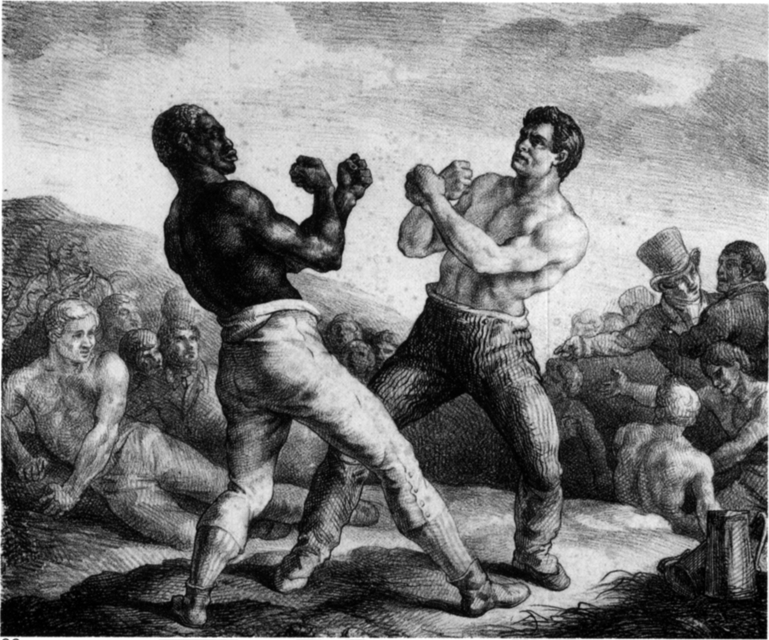
Of course, they knew nothing about boxing (which is not the only possible source of this phrase, but a likely reference for Thoreau's time).
Because it's not that at all. It's not about pulling a heavy weight. The image shouldn't be of a person turning away from the weight, leaning away from the burden in an effort to pull it forward. The image is not one of turning away, but of standing up and facing an opponent, especially when it feels as if that opponent has nearly beaten you.
The image, then, is not of burden, but of bravery, and it's important to keep that in mind when we're reading this passage. Thoreau uses the expression, it seems, as a way of remarking on the difficulty of the act. It reminds me of a line from an essay by Annie Dillard that I especially like, one in which she describes a flight by the stunt pilot Dave Rahm:
His was pure energy and naked spirit. I have thought about it for years. Rahm's line unrolled in time. Like music, it split the bulging rim of the future along its seam. It pried out the present. We watchers waited for the split-second curve of beauty in the present to reveal itself.And perhaps there's something here, amid Thoreau and Dillard, about my relationship to running. The run, often, is a time of distraction, a time during which the mind moves aimlessly, not idling but simply wandering. But there are times, especially when the effort of the run is high, of focus--not a focusing of the mind, but a quieting of it; not the moment-to-moment remembering what's just happened or projecting what might happen next; not hope, not desire, not wish, merely presence.
And it's at these moments, often, that the physical suffering of running is at its greatest, but in these moments, toeing this line, there isn't the desire to escape the suffering or to ignore it--merely the acceptance of it in the present experience of the moment. And with that acceptance, strangely enough, the suffering ceases to be suffering--I guess because when we suffer, we wish for things to be other than as they are.
I've recently heard several runners remark on the feeling they had when they ran their best times, and all of them have said that these were the races when they hurt the least. I can't help but think that it's not because the physical experience was different--they didn't run a fast time because their body didn't hurt while putting forth a maximal effort. Instead, I think it's because the relationship to the physical experience was different--that instead of wishing for the hurt to be easier/over/different, they were fully present with the experience.
No comments:
Post a Comment